Introduction
Welcome to 7SoftTech Seamless API documentation!
Terms
| Term | Description |
|---|---|
| Casino | the operator who works with the players |
| Game provider | the final content provider |
| PROVIDER_URL | games content provider api endpoint |
| WALLET_URL | wallet server api endpoint |
| CASINO_ID | casino’s identifiers |
| AUTH_TOKEN | API key sent in the X-API-KEY header of every request the casino makes to PROVIDER_URL |
| CALLBACK_SECRET | shared secret used to sign the callbacks made to WALLET_URL, see Signed wallet callbacks |
Before integration
- Provide your
Project NameandWALLET_URLto us. PROVIDER_URL,WALLET_URL,CASINO_IDandAUTH_TOKENwill be provided by one of our managers.- Implement the API Methods you call and the API Callbacks you answer.
- We run the certification suite
against your
WALLET_URLand send you the report. Go-live follows from a clean run.
All API Methods live under /v2/ on PROVIDER_URL. There is no other version
to choose from — everything in this documentation describes the current API.
The v1= prefix on the X-Signature header below is not an API version.
It names the signature scheme, so a future scheme can be rolled out next to it,
and it stays v1 whatever the API version is. Send it exactly as shown.
Security
The two directions of traffic are authenticated differently — do not mix them up when implementing either side.
API calls to PROVIDER_URL
The API Methods you call on PROVIDER_URL are
authenticated with an API key (AUTH_TOKEN), issued together with the rest of
your credentials before the integration starts.
- Send the key in the
X-API-KEYheader of every request:
X-API-KEY: {AUTH_TOKEN}- The key is a shared secret: keep it server-side only, never expose it to the player’s browser or to the game client. If it leaks, ask us for a new one.
- A missing or wrong key is answered with
HTTP 401. A valid key from an IP that is not on your allow-list is answered withHTTP 403.
Callbacks to WALLET_URL
The API Callbacks we send to your
WALLET_URL do not carry X-API-KEY — that header only applies to the
direction above. See Signed wallet callbacks below
for how to authenticate this direction.
Do not rely on X-API-KEY to authenticate incoming wallet callbacks — we
never send it on this path. Use the callback signature described below, and
keep an IP allowlist as a second layer regardless.
Signed wallet callbacks
Every callback to WALLET_URL — authenticate,
balance, bet,
win, cancel — can be signed with
HMAC-SHA256, using a CALLBACK_SECRET issued to you separately from
AUTH_TOKEN. Ask your account manager whether signing is enabled for your
integration.
Headers
| Header | Example | Meaning |
|---|---|---|
X-Casino-Id | 1000 | your CASINO_ID — which secret was used to sign |
X-Timestamp | 1754380800 | unix seconds at signing time |
X-Nonce | d1e2f3a4b5c60718293a4b5c6d7e8f90 | 16 random bytes, hex-encoded |
X-Signature | v1=9a5844bb... | the signature scheme (always v1, unrelated to the API version) and the digest |
Wire format
- Signed POST:
[POST] {WALLET_URL}/with the parameters documented on each callback page as a JSON object body, plus the headers above.
Signature
signing string = "{X-Timestamp}.{X-Nonce}.{payload}"
payload        = the raw request body, exactly as received
X-Signature    = "v1=" + hex(hmac_sha256(signing string, CALLBACK_SECRET))
                  ^^^^ the signature scheme, not the API version — always this literal
Compute the signature over the payload exactly as received — do not re-encode or re-order the JSON body. There is no canonicalization step on our side, so none is needed on yours.
What to verify
All four checks are required — skipping any one of them leaves a gap:
- Signature — recompute it and compare with a constant-time function
(e.g. PHP’s
hash_equals), never==. - Timestamp — reject if
abs(now - X-Timestamp)is more than 300 seconds. - Nonce — reject an
X-Nonceyou have already seen; cache seen nonces for at least 300 seconds (a 600 second TTL gives comfortable margin). transaction_id— a repeatedtransaction_idmust return the original result, not apply the callback again. We retry transient failures, so a duplicate is a normal event, not an attack — see the note on Bet.
Keep your existing IP allowlist too; the signature does not replace it.
Test vector
Reproduce this to confirm your implementation is compatible before we enable signing for you:
CALLBACK_SECRET = 0123456789abcdef0123456789abcdef0123456789abcdef0123456789abcdef
X-Timestamp     = 1754380800
X-Nonce         = d1e2f3a4b5c60718293a4b5c6d7e8f90
payload         = {"user_id":42,"action":"bet","amount":1.50,"currency":"EUR","transaction_id":"tx-1001"}

X-Signature     = v1=d4260b8eea5cce8da2244166b2e4d1dff47ef11f37c3b173333c168b94d026dd
printf '%s' '1754380800.d1e2f3a4b5c60718293a4b5c6d7e8f90.{"user_id":42,"action":"bet","amount":1.50,"currency":"EUR","transaction_id":"tx-1001"}' \
| openssl dgst -sha256 -hmac '0123456789abcdef0123456789abcdef0123456789abcdef0123456789abcdef'A rejected signature is entirely your endpoint’s decision — reject it the
same way you already reject an unrecognized request (e.g. HTTP 401). We
do not require a specific error body on this path.
Request and response format
- API Methods are called by the casino on
PROVIDER_URL.rungame,create-freespinsandcancel-freespinsarePOSTrequests with a JSON object body; the rest areGETrequests with query parameters. - API Callbacks are called by the game provider on
WALLET_URLasPOSTrequests with a JSON object body. - Every response, in both directions, is a JSON object.
- Monetary values use two different units, so watch out when mapping them:
- callback
amountandbalancefields are decimal values in the major currency unit (for example0.25= 25 cents), - the Gift Spin
betparameter is an integer in cents.
- callback
- Every callback must return either the documented success payload or an error response.
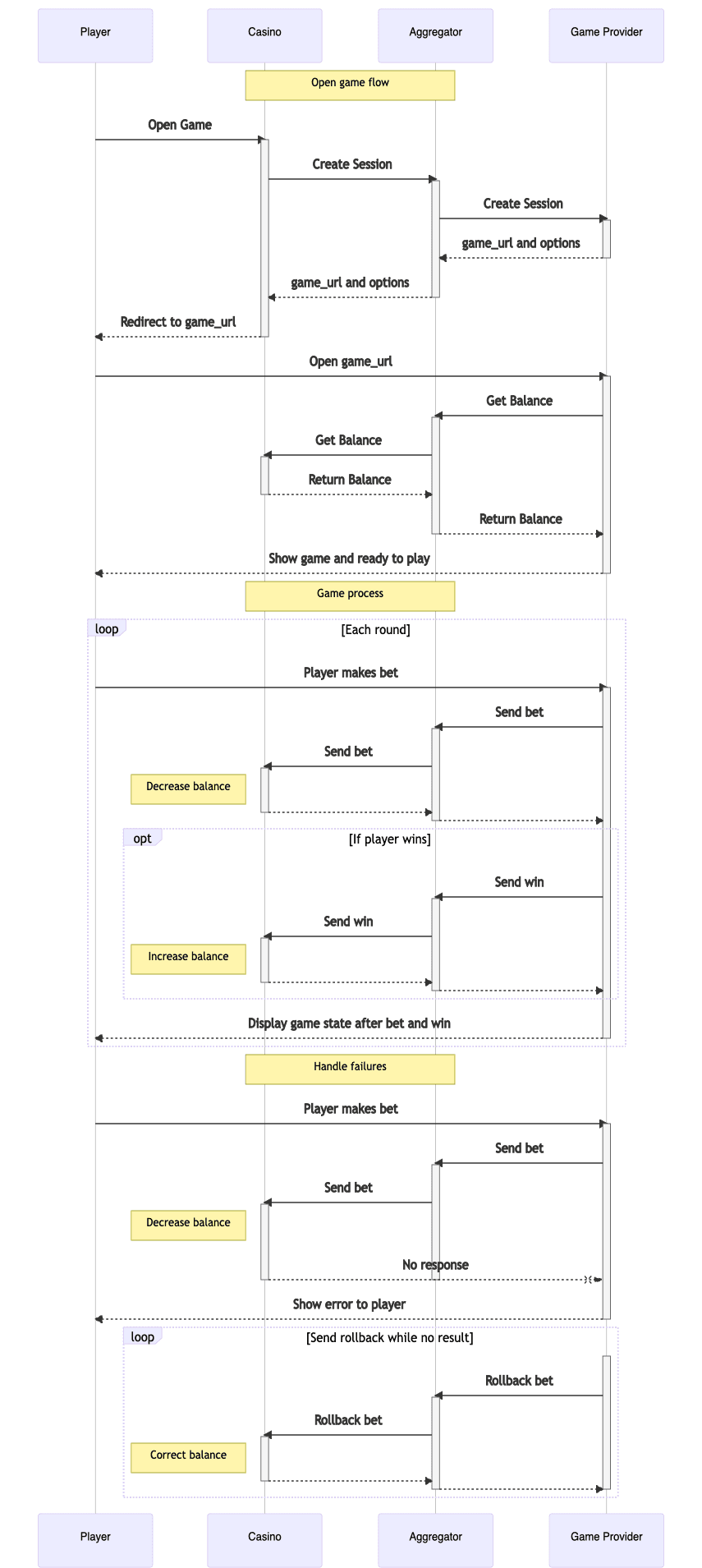
Workflow